

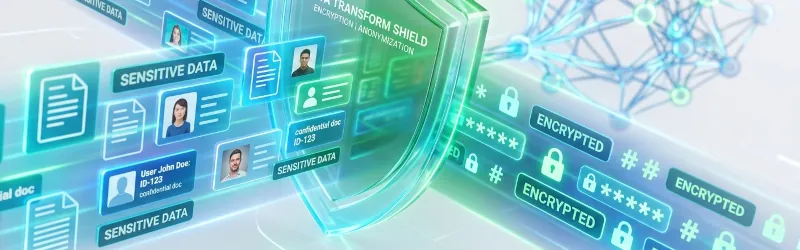
In today's digital age, machine learning (ML) models hold the potential to transform businesses' decision-making processes, operational efficiency, and customer experiences. However, the success of these models often depends on access to large and diverse datasets. Among these datasets are sensitive data that can directly affect individuals' privacy and companies' reputations. Therefore, ensuring data privacy and security in machine learning processes has become a critical necessity. In this article, we will examine in detail the anonymization and encryption techniques used to protect sensitive data when training ML models.
The Importance of Protecting Sensitive Data in Machine Learning
Machine learning models can be trained on sensitive data such as personal information, financial records, health data, or trade secrets. Misuse or leakage of this data not only leads to legal and regulatory violations (such as GDPR and KVKK) but can also cause serious reputational damage to companies and result in significant costs. Data protection is not just a compliance matter — it is also the foundation of building customer trust and conducting business ethically. In the AI solutions we develop at Corius, compliance with these ethical and legal frameworks is among our top priorities.
Data Anonymization Techniques
Anonymization is the process of making data non-associable with individual identities. This enhances privacy by making it difficult or impossible to identify individuals in a dataset. Here are some common anonymization techniques:
- K-Anonymity: Ensures that every individual in a dataset is indistinguishable from at least k-1 other individuals. That is, there are at least k records with a given combination of attributes.
- L-Diversity: Extends K-Anonymity by ensuring that the values of sensitive attributes within the same k-anonymity group are also diverse. This prevents attackers from inferring the sensitive information of a group.
- T-Closeness: Goes one step beyond L-Diversity. It aims for the distribution of sensitive attribute values within an anonymity group to resemble the distribution across the entire dataset. This provides stronger protection against inference attacks.
- Differential Privacy: Guarantees that the presence or absence of an individual record does not significantly change the outcome of an analysis by adding small, random noise to the dataset. This maximally protects individual privacy while allowing meaningful statistical insights to be drawn from the overall dataset.
Data Encryption Techniques
Encryption is a traditional and powerful way to protect data against unauthorized access. However, in the context of machine learning, performing computations on encrypted data requires specialized techniques.
- Homomorphic Encryption: This technology allows computations to be performed on data while it remains encrypted. Results are also obtained in encrypted form and can only be decrypted by those with the correct keys. This enables sensitive data to be securely processed even in third-party cloud services. Our R&D work in this area offers innovative solutions to our clients.
- Secure Multi-Party Computation (MPC): A cryptographic protocol that allows multiple parties to jointly compute a function over their private inputs without revealing those inputs to each other. When training ML models, it enables different companies to build a shared model without combining their sensitive data.
- Federated Learning: An approach where, instead of sending datasets to a central server, the ML model is trained locally on different devices or servers and only model updates (weights or gradients) are sent to a central server. This enhances data privacy while preserving the model's overall performance. Such approaches are frequently considered in our custom software development processes.
Practical Challenges and Best Practices
Protecting sensitive data and training machine learning models can involve complex challenges. Here are some key points to consider:
- Choosing the Right Technique: Each anonymization or encryption technique has its own advantages and disadvantages. The most suitable technique or combination of techniques must be selected based on the type and sensitivity of the data, the model's requirements, and applicable regulations.
- Balancing Performance and Accuracy: Anonymization and encryption can sometimes affect model accuracy or training time. Finding an optimal balance between privacy and utility is important. Corius's digital transformation consultancy team can guide you in striking this balance.
- Continuous Auditing and Updates: Data privacy and security are not one-time tasks. As threats and technologies continuously evolve, the techniques in use must be regularly audited and updated. With our enterprise data services, we support businesses throughout these processes.
- Legal Compliance: Legal and technical expertise must be evaluated together to achieve full compliance with data protection laws such as GDPR and KVKK.
While machine learning offers tremendous opportunities for the business world, the protection of sensitive data must never be overlooked. Anonymization and encryption techniques play a key role in establishing this balance. With the right strategies and advanced technology solutions, you can develop innovative ML applications while ensuring the highest level of data privacy. At Corius, we provide comprehensive solutions to help businesses navigate these complex processes with confidence.